Bachelor of Mechanical Engineering Technology (Agricultural Systems) with Honours
Overview
Bachelor of Mechanical Engineering Technology (Agricultural Systems) with Honours is a programme offered under the Faculty of Mechanical and Manufacturing Engineering Technology. The programme focuses on the application of mechanical engineering technology in agricultural systems and agro-based industries. Students who undertake this programme will learn about the design, operation, maintenance, and management of agricultural machinery and systems, particularly those used in crop production, livestock farming, post-harvest handling, irrigation, and mechanised farming operations.
In addition, students are exposed to knowledge in areas such as agricultural machinery maintenance, automation in agriculture, sustainable farming technology, energy utilisation in agricultural systems, and farm mechanisation planning. The programme also prepares students with practical competencies in technical reporting, system analysis, equipment maintenance management, and project planning relevant to agricultural engineering technology.
Generally, the field of agricultural systems engineering technology plays a vital role in supporting modern and sustainable agriculture. This programme covers a broad scope of agricultural system operations, enabling graduates to contribute effectively to productivity enhancement, technological innovation, and mechanisation development in the agricultural sector.
Career Path
Career Path Opportunities
1. Agricultural Engineering Technologist
- Design, operate, and improve agricultural machinery and systems
- Support mechanised farming, irrigation, and post-harvest technologies
- Work in farms, plantations, R&D centres, or agro-technology firms
2. Agricultural Machinery / Equipment Engineer
- Handle installation, testing, maintenance, and troubleshooting of farm machinery
- Involved in tractors, harvesters, irrigation equipment, and processing machines
3. Maintenance & Service Engineer
- Plan and manage maintenance of agricultural and mechanical systems
- Ensure machinery efficiency, safety, and reliability in farms or agro-industries
4. Farm Mechanisation Officer / Agricultural Technologist
- Advise on modern farming technologies and mechanisation strategies
- Commonly employed by government agencies, cooperatives, or large-scale farms
5. Automation & Precision Agriculture Technologist
- Work with smart farming technologies such as sensors, GPS systems, and automated equipment
- Support Industry 4.0 and digital agriculture initiatives
6. Production or Operations Engineer
- Manage agro-processing plants and production systems
- Oversee workflow, quality control, and equipment performance
7. Technical Executive / Engineering Supervisor
- Supervise technical teams and daily operations
- Coordinate projects, reporting, and system optimisation
8. Sales & Technical Support Engineer
- Provide technical consultation for agricultural machinery and equipment suppliers
- Bridge technical knowledge with customer needs
9. Entrepreneur / Agri-Tech Business Owner
- Start businesses in farm services, machinery maintenance, precision agriculture, or agro-machinery supply
- Engage in innovation-driven agricultural solutions
10. Further Studies & Professional Growth
- Pursue:
- Master’s or PhD in Engineering, Agricultural Engineering, or related fields
- Professional certifications in maintenance management, automation, or project management
- Career advancement into engineering management, consultancy, or research roles
Employment Sectors
- Agro-based industries
- Manufacturing and machinery companies
- Plantation and farming enterprises
- Government agencies and research institutions
- Automation and smart agriculture companies
Subject
CORE COURSES
Semester 1
MMK10103 Sains Bahan [Materials Science]
MMK10203 Statik dan Dinamik [Statics and Dynamics]
MMK10403 Grafik Kejuruteraan [Engineering Graphics]
MMK10502 Teknologi Bengkel [Workshop Technology]
MMK15102 Biologi Gunaan [Applied Biology]
Semester 2
MMK10303 Asas Elektrikal dan Elektronik [Basic Electrical and Electronics]
MMK11203 Mekanik Bendalir [Fluid Mechanics]
MMK11603 Rekabentuk Berbantu Komputer [Computer Aided Design]
MMK11502 Teknologi Pembuatan [Manufacturing Technology]
MMK15202 Pengenalan kepada Pertanian [Introduction to Agriculture]
Semester 3
MMK20103 Termodinamik [Thermodynamics]
MMK20203 Kekuatan Bahan [Strength of Materials]
MMK21103 Kejuruteraan Berbantu Komputer [Computer Aided Engineering]
MMK11302 Pengaturcaraan Komputer [Computer Programming]
MMK25102 Teknologi Pengeluaran Tanaman Ladang [Plantation Crop Production Technology]
Semester 4
MMK21203 Pemindahan Haba [Heat Transfer]
MMK24103 Sistem Hidraulik dan Pneumatik [Peneumatic and Hydraulic Systems]
MMK24103 Kawalan dan Instrumentasi [Instrumentation and Control]
MMK25202 Kejuruteraan Tanah [Soil Engineering]
MMK25302 Teknologi Pengeluaran Akuakultur dan Penternakan [Livestock and Aquaculture Production Technology]
MMK25402 Teknologi Pengeluaran Tanaman Makanan [Food Crop Production Technology]
Semester 5
MMK34103 Automasi dalam Sistem Pertanian [Automations in Agricultural Systems]
MMK11403 Pengurusan Projek [Project Management]
MMK11103 Kawalan Kualiti [Quality Control]
MMK35103 Teknologi Lepas Tuai [Postharvest Technology]
MMK31204 Projek Tahun Akhir I [Final Year Project I]
Semester 6
MMK34203 Projek Rekabentuk Pertanian [Agricultural Designn Project]
MMK31103 Ergonomik dan Keselamatan [Ergonomics and Safety]
MMK35203 Teknologi Pertanian Tepat [Precision Farming Technology]
MMK35303 Tenaga Diperbaharui dalam Sistem Pertanian [Renewable Energy in Agriculture Systems]
MMK41206 Projek Tahun Akhir II [Final Year Project II]
Semester 7
MMK44103 Jentera dan Kuasa Ladang [Farm Power and Machinery]
MMK45103 Pengurusan Sisa Pertanian dan Kejuruteraan Kepenggunaan [Agricultural waste Management and Utilization Engineering]
MMK45203 Persekitaran Terkawal dalam Pertanian [Controlled Environment in Agriculture]
MMK45303 Kejuruteraan Pemprosesn Makanan [Food Processing Engineering]
Semester 8
MMK49912 Latihan Industri [Industrial Training]
Gallery
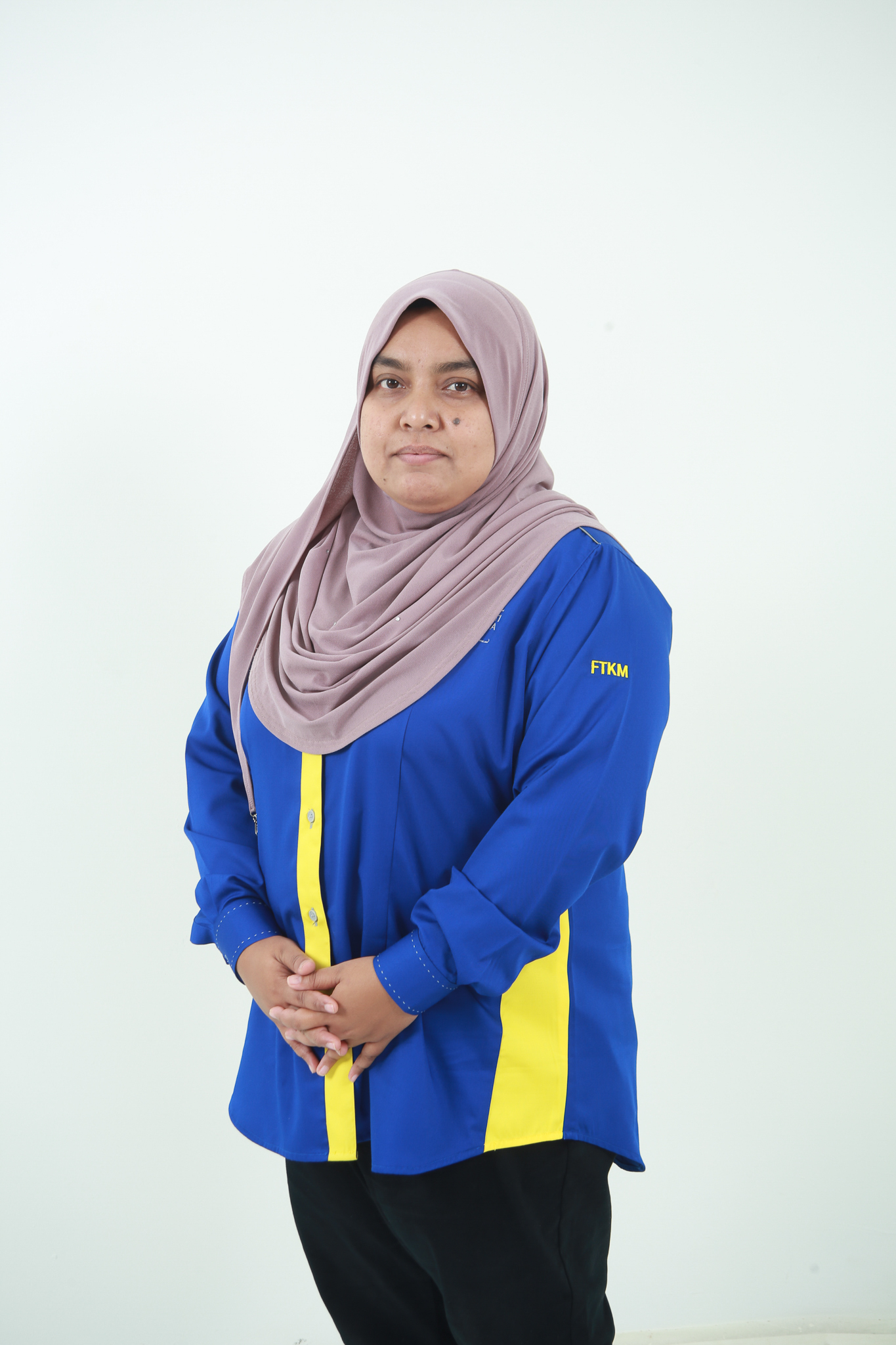
DR. NORAWANIS BINTI ABDUL RAZAK
Programme Educational Objective (PEO)
- Engineering technology graduates engaged in the field of Mechanical engineering technology as demonstrated through career advancement.
- Engineering technology graduates who are members and contribute to professional society.
- Engineering technology graduates embracing in life- long learning** or pursuing continuing education opportunities.
- Engineering technology graduates who are technopreneurs.
Programme Outcome (PO)
- Apply knowledge of mathematics, natural science, computing and engineering fundamentals and an engineering specialization to defined and applied engineering procedures, processes, systems or methodologies
- Identify, formulate, research literature and analyse broadly-defined engineering problems reaching substantiated conclusions using analytical tools appropriate to their discipline or area of specialisation with considerations for sustainable development
- Design solutions for broadly-defined engineering technology problems and contribute to the design of systems, components or processes to meet identified needs with appropriate consideration for public health and safety, whole-life cost, net zero carbon as well as resource, cultural, societal, and environmental considerations as required
- Conduct investigations of broadly-defined engineering problems; locate, search and select relevant data from codes, data bases and literature, design and conduct experiments to provide valid conclusions
- Select and apply, and recognize limitations of appropriate techniques, resources, and modern engineering and IT tools, including prediction and modelling, to broadly-defined engineering problems
- Analyze and evaluate sustainable development impacts to: society, the economy, sustainability,
health and safety, legal frameworks, and the environment, in solving broadly-defined engineering problems - Understand and commit to professional ethics an norms of engineering technology practice and
adhere to relevant national and international laws. Demonstrate an understanding of the need for diversity and inclusion - Function effectively as an individual, and as a member or leader in diverse and inclusive teams and in multi-disciplinary, face-to-face, remote and distributed settings
- Communicate effectively and inclusively on broadly defined engineering activities with the
engineering community and with society at large, by being able to comprehend and write effective reports and design documentation, make effective presentations, taking into account cultural, language, and learning differences. - Apply knowledge and understanding of engineering management principles and economic decision making to one’s own work, as a member and leader in a team and to manage projects in multidisciplinary environments.
- Recognize the need for, and have the ability for i) independent and life-long learning and ii) critical thinking in the face of new specialist technologies
- Demonstrate ability to engage effectively in self-improvement initiatives for career, professional or educational goals and engage in entrepreneurial activities.